
Board Foot Calculator
Enter the dimensions of your lumber to calculate board feet and total cost.
Add your first item to begin.
Board Foot Calculator – Lumber, Timber & Wood Measurement Tool
A detailed, practical guide to understanding and using board feet for measuring lumber volume. Learn the formula, conversions, examples, buying and budgeting tips, plus FAQs — everything you need to plan wood projects confidently.
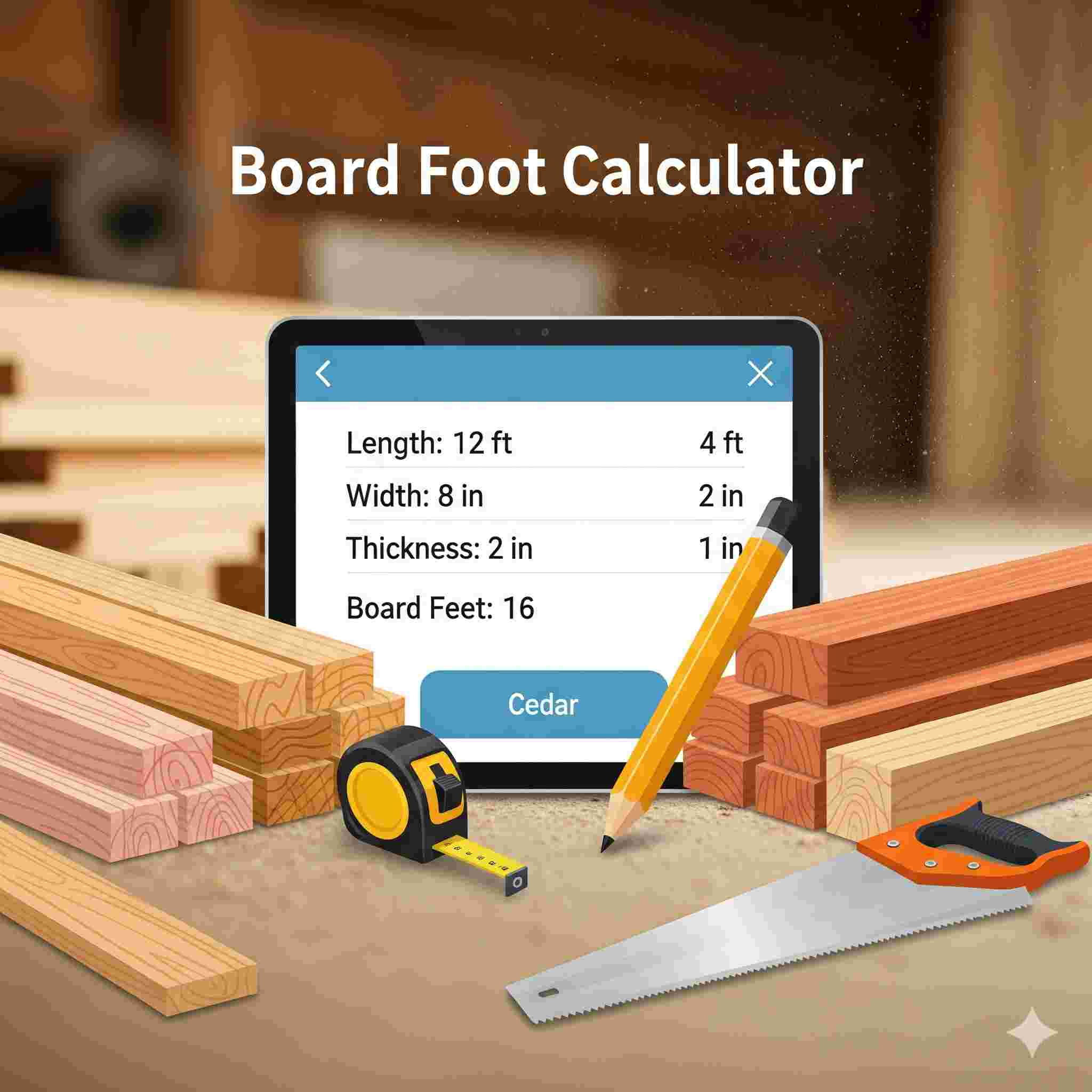
Board Foot Calculator – Overview
This page is a comprehensive reference for anyone who needs to calculate board feet for lumber, timber, and wood products. While the interactive calculator widget has been removed from this page by request, this guide provides the exact formulas, examples, conversion factors, and step-by-step instructions you need to compute board feet precisely and consistently.
Whether you’re a woodworker, contractor, or homeowner planning a deck, furniture, or renovation, understanding board feet helps you estimate quantity, cost, and waste more accurately with board foot calculator.
What is a Board Foot?
A board foot (BF) is a unit of volume used in the lumber and timber industry. One board foot equals the volume of a board that measures 1 inch thick × 12 inches wide × 12 inches long. In cubic inches that is 144 in³, and in cubic feet it is 1/12 ft³ (≈ 0.083333 ft³).
Board feet standardize the comparison of pieces with differing thickness, width, and length into a single volumetric measure. When suppliers quote a price “per board foot”, they are pricing by volume rather than by piece count.
Quick facts:
- 1 BF = 144 cubic inches.
- 1 BF = 1/12 cubic foot ≈ 0.083333 ft³.
- 1 BF ≈ 0.002359737 cubic meters (m³).
Board Foot Calculator Formula
The standard formula for board feet when using inches for all dimensions is:
Board Foot calculator (BF) = (Thickness (in) × Width (in) × Length (in)) ÷ 144
If length is given in feet (and thickness/width in inches), a handy variant is:
BF = (Thickness (in) × Width (in) × Length (ft)) ÷ 12
Why it works:Board foot calculator multiplying thickness × width × length gives cubic inches; dividing by 144 converts cubic inches into board feet.
Per-piece, quantity and waste
To compute the total for multiple identical pieces:
Total BF = BF per piece × Quantity
To include a waste allowance (for defects, trimming, saw kerf):
Total BF with waste = Total BF × (1 + Waste% / 100)
Step-by-Step Examples
Example 1 — Standard 2×4 board (nominal 2×4, actual 1.5″ × 3.5″), 8 ft long
Using actual dimensions:
(1.5 in × 3.5 in × 96 in) ÷ 144 = (504) ÷ 144 ≈ 3.5 BF per piece
If you need 20 pieces: 3.5 × 20 = 70 BF. Add 10% waste → 70 × 1.10 = 77 BF total ordered.
Example 2 — 1″ × 12″ × 10 ft board
(1 × 12 × 120) ÷ 144 = 1440 ÷ 144 = 10 BF
Example 3 — Beam 4″ × 8″ × 12 ft
(4 × 8 × 144) ÷ 144 = 4608 ÷ 144 = 32 BF
Example 4 — Converting BF to cubic meters
Given 100 BF: 100 × 0.002359737 ≈ 0.2359737 m³.
These examples demonstrate consistent calculation practice: always use the actual dimensions unless you intentionally price using nominal sizes and the supplier quotes that way.
Nominal vs Actual Size
Nominal dimensions (like 2×4 or 1×6) are the traditional names used in lumber trade. After drying and surfacing, the actual dimensions are smaller. For example, a nominal 2×4 typically measures 1.5″ × 3.5″ in actual dimension.
Common nominal → actual approximations:
- 1×4 → ~0.75″ × 3.5″
- 1×6 → ~0.75″ × 5.5″
- 2×4 → ~1.5″ × 3.5″
- 2×6 → ~1.5″ × 5.5″
- 2×8 → ~1.5″ × 7.25″
- 2×10 → ~1.5″ × 9.25″
- 2×12 → ~1.5″ × 11.25″
Regional and mill differences can slightly change actual sizes—always measure when exact precision matters. If a supplier quotes by nominal size (e.g., “2×4 per linear foot at $X”), clarify whether the price is per nominal or per BF to compare fairly with board foot calculator.
Conversions
Useful conversion factors:
- 1 board foot (BF) = 144 cubic inches = 1/12 cubic foot ≈ 0.083333 ft³.
- 1 BF ≈ 0.002359737 cubic meters (m³).
- 1 cubic foot (ft³) = 12 BF.
- 1 cubic meter (m³) ≈ 423.776 BF.
Conversion examples:
- To convert BF → ft³: divide BF by 12.
- To convert ft³ → BF: multiply ft³ by 12.
- To convert BF → m³: BF × 0.002359737.
| Value | Equivalent |
|---|---|
| 12 BF | 1 ft³ |
| 100 BF | 8.333 ft³ ≈ 0.23597 m³ |
| 423.776 BF | 1 m³ |
Waste Factor & Yield
In real projects, you rarely use every square inch of wood you buy. Knots, checks, bow, cup, twist, cross-grain, end trimmings and saw kerf all reduce usable yield. Add a waste factor to orders to avoid running short with board foot calculator.
Typical waste guidelines:
- 5–8% — Framing, rough carpentry, short repetitive cuts.
- 8–12% — Trim carpentry, general woodworking projects.
- 10–15% — Furniture hardwoods, joinery, where matching grain/colour is needed.
- 15%+ — Wide slabs, figured wood, tight grain matching or high defect rates.
How to include waste: Multiply your total BF by 1 + (waste% ÷ 100). Example: 50 BF required; with 10% waste → order 55 BF.
Tip: For boards you will resaw or dimension, expect extra loss due to planer/thicknessing and resaw kerf. Plan accordingly.
Pricing & Budgeting by Board Feet
Many lumber suppliers price hardwoods and specialty timbers by the board foot. Price per BF varies widely by species, grade, width, and drying method (air-dried vs kiln-dried).
Pricing factors to watch:
- Species — Walnut, cherry, and teak are commonly more expensive than poplar or pine.
- Grade — Higher grades (FAS/Select) yield more clear, wide boards with fewer defects.
- Width and length — Wider and longer boards are rarer and often command premium per BF prices.
- Drying — Kiln-dried stock often costs more but is more stable for furniture projects.
- Mill vs Retail — Mill direct prices differ from retail yard prices after milling, drying, and handling.
To estimate cost:
Estimated Cost = Price per BF × Total BF (including waste)
Example: 80 BF total × $6.25/BF = $500.00.
How to Use This Guide (Step-by-Step)
- Decide whether you’ll measure in actual dimensions (inches) or use nominal sizes (2×4, etc.). Actual is recommended for accuracy.
- Measure thickness, width, and length in inches (or convert feet to inches by ×12).
- Use the BF formula: (T × W × L) ÷ 144 to compute BF per piece.
- Multiply by quantity to get a project total BF.
- Add waste factor (5–15% depending on project) to the total BF to determine how much to order.
- If needed, multiply the final BF by price per BF to get estimated cost.
- Convert to m³ or ft³ if your supplier uses metric or volume pricing.
Common Mistakes to Avoid
- Mixing nominal and actual dimensions in the same calculation — be consistent.
- Forgetting to convert feet to inches when using the inches formula.
- Not accounting for waste and kerf — especially critical for furniture and finish work.
- Assuming price per piece equals price per BF — always ask the supplier how they price stock.
- Failing to measure board width at several points — boards vary in width; use average or the narrowest usable width for precise planning.
Pro Buying Tips
- Inspect boards personally — look for twist, cup, knots, and checks. Choose straighter, flatter pieces for stability.
- Ask for the mill tally or board list when buying in bulk — it helps track species, dimensions, BF, and price.
- Prefer slightly more BF than your minimum — it reduces project delays and gives matchable grain options.
- When working with expensive species, buy a little extra for grain and color matching.
- Keep records: species, grade, BF purchased, price per BF, and invoice details help future estimation and resale.
Glossary
- Board Foot Calculator (BF)
- Unit of volume equal to 1 in × 12 in × 12 in (144 in³).
- Nominal Size
- The named size of lumber (e.g., 2×4) before drying/machining.
- Actual Size
- The real measured dimension after drying and surfacing (e.g., 2×4 → 1.5×3.5 in).
- Kerf
- Material lost to saw cut width during milling or resawing.
- FAS (Firsts and Seconds)
- A high grade for hardwoods indicating wide, clear usable boards.
Board Foot Calculator — Frequently Asked Questions
Is a board foot the same as a square foot?
No — a square foot measures area (length × width). A board foot measures volume (thickness × width × length). For example, a 1″ thick 1 sq ft board equals 1 BF, while a 2″ thick 1 sq ft board equals 2 BF.
How many board feet are in a 2×4×8?
Using actual size (1.5″ × 3.5″ × 96″): (1.5 × 3.5 × 96) ÷ 144 ≈ 3.5 BF.
What does 4/4, 5/4, and 8/4 mean?
These indicate rough thickness in quarters of an inch: 4/4 = 1″, 5/4 = 1.25″, 8/4 = 2″. Surfaced lumber (finished) will be slightly thinner.
Can I convert board feet to cubic meters?
Yes. 1 BF = 0.002359737 m³. Multiply BF by this factor to get cubic meters.
What waste factor should I use?
For framing use 5–8%; for furniture-grade hardwoods use 10–12%; for wide slabs or tight matching use 15% or more.
Useful Links
Internal Tools (ifscx.com)
Authoritative External References
Plan. Price. Build.
Use this guide to calculate board feet, estimate materials and budget, and reduce waste on your next woodworking or building project.
Last updated : April 18 , 2026